Showing posts with label kayak. Show all posts

Thursday, June 11, 2026

Upper Pindar, Multiday Fun In Uttarakhand, India

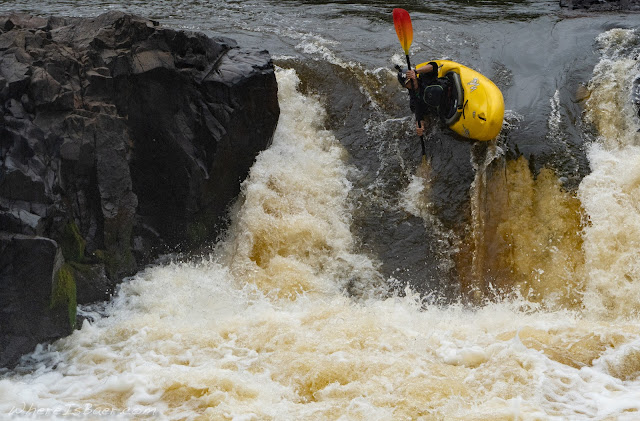
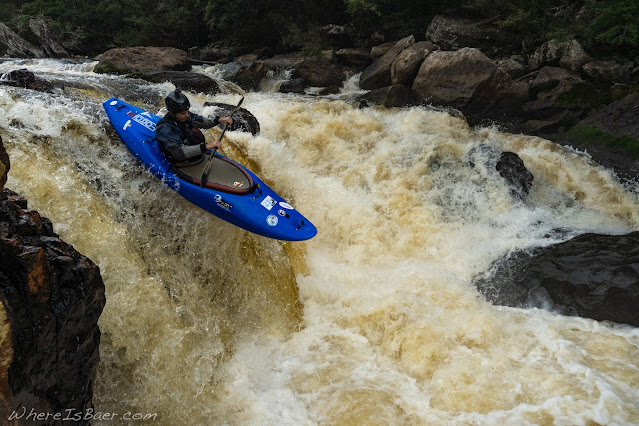
Kayaker on edge, orange rock, and lots of whitewater
Damin Singh getting his lean on the Upper Pindar


Put In:          GPS (30°06'07.2"N 79°54'57.7"E) Note: small bridge
Take Out:     GPS (30°01'16.5"N 79°40'46.3”E) Note: new bridge not on map yet
Class:           Day One class 3-4, day Two class 5, day Three class 4 

big rolling green hills framing snow capped peaks in the background
Mount Nanda Devi

Description:

The Pindar River flows from the glacial expanse on the southern escarpment of the Nanda Devi Mountain (25,643 feet) the second-tallest peak in India. A full-day drive on fairly good roads (for India) brought us (Arjun Sagoi, Daman Sing, Georgia Farmer, and myself, Chris Baer) to a pass with a significantly worse road and spectacular Himalayan views. Up and over the pass we went into the Pindar Valley and to the tiny village of Khati. We stayed in the loft of a local merchant, who made us a nice breakfast the following morning. The hospitality of the mountain folks is genuine, giving. 

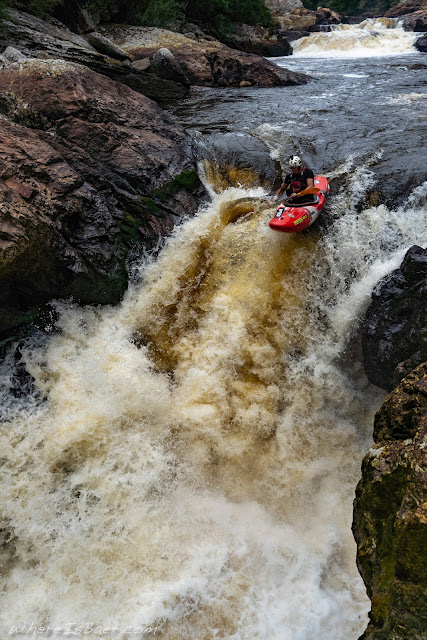
kayaker in lots of whitewater sliding between orange rocks
Arjun Sagoi sliding into the Upper Pindar

Day one

Arriving at the put-in bridge, we were joined by a portion of the town that was very inquisitive about our whitewater costumes and our ability to shove all of our multiday equipment into the stern of our kayaks. Once the population of Khati was satisfied with group photos and words of warning, we put on. 

women in authentic local robes watching kayakers prepare for mission
locals of Khati looking on as we prepare our equipment

This first section is relatively mellow; most of the river meanders through a beautiful, dense forest, with massive trees that occasionally canopy the entire river. The whitewater is mainly class 3 with one or two class 4 moves. We traveled five miles to our riverside camp (30°05'48.2"N 79°51'15.2"E) under a bridge, and just outside of the village of Dhaula. I certainly wouldn’t say this was my favorite camp. The bridge looked to be in an ever-evolving state of disrepair and clattered loudly with every person, donkey, or vehicle that crossed. l awoke the following morning to the clatter of the bridge and chimes of bells. The bells were attached to donkeys (I assume the bells are used to track the donkeys when they invariably wander off into the jungle). The donkeys were being used as beasts of burden to haul sand from the beach for the construction of concrete structures in the neighboring village. 

bright blue water, kayaker mostly underwater,
Arjun Sagoi getting pitted on the Upper Pindar

Day Two 

The river passes through a large sedimentary deposit. We are paddling in the dry season, but during the monsoon season, the river erodes a new path through this soft sedimentary section every year. This means we are paddling between massive boulders; there are siphons and undercuts in every rapid. With the combination of a high noon start and very difficult scouting options, our downstream progress was exhaustingly slow. In four hours, we made it only one mile downstream, spending the majority of our time scrambling over massive boulders in the attempt to get a limited peek at the next horizon line. We managed to paddle all but one rapid in this difficult and dangerous sedimentary section. We set camp amongst the giant boulders with one last significant rapid to paddle in the morning. We quickly started to refer to this last rapid as Breakfast Rapid, as we would get to enjoy it the following morning.

green kayak sliding down bright blue water
Damin Singh putting together one of the longer and relatively sketchy rapids


kayaker paddling between sieves on blue water
Damin Singh finding his route amongst the sieves 

Day Three

Breakfast Rapid deserved a solid scout; thankfully, it paddled fairly well and was a great way to end this boulder-laden section. The river then mellows in difficulty, but not in scenery. Deep rocky gorges with sheer cliffs and fun class 4 rapids are in store. Some of these rapids are fairly hard to scout, and the rock structure continues to be fairly undercut. After five-ish miles of beautiful canyons, the river starts to open. We found ourselves in shallow glacial deposits, where the river would shoal out. These shoals are not fun. There is a new bridge that would make a good take out option GPS (30°01'42.4"N 79°44'50.3”E). Our shuttle logistics got a bit mixed up, and we made our way down a total of 13 miles on day three to yet another new bridge. The crew was all a bit cold and excited for dry clothes and a good meal.

green kayak nose in the air scooting away from waterfall
Damin Singhwith a pretty wheelie on the last ledge of Breakfast Rapid 


Chris Baer looking smug
adventure by Chris Baer

Saturday, May 30, 2026

Alakananda River, Uttarakhand, India

Canyon section of the Alakananda River


Put In:            GPS (30°29'48.2"N 79°28'37.4"E) Note: upstream, river left of bridge, steep slope
Take Out:       GPS (30°24'28.7"N 79°23'13.9"E) Note: confluence with Birahi Ganga
Class:             3-4 with one burly class 5 landslide rapid 

Description:

                      Initially, we attempted to gain access to the canyon via a hydroelectric scheme that is located upstream of our eventual put-in location. This upstream access would have allowed us to gain a few more rapids. Unfortunately, we were turned away by the workers. I do believe this access could be granted, but it will definitely take some shmoozing of multiple groups; none of the employees seemed willing to say yes outright. 

kayaker amongst huge boulders and blue water,
Varun Kamath in the depths of the Put In Rapid 

Arriving at the foot bridge, a quick scout revealed access downstream and on river right, or upstream river left, over the hill, and with a steep embankment to the water’s edge. The upstream access, although a little more tedious, allows for another fun rapid.

green kayak, big whitewater, house size boulders
Damin Singh maneuvering around house size boulders

There is essentially no warm-up for the first rapid, and scouting is difficult because the main line is on the far side of the river and obscured by a house-sized boulder. Thankfully, the main line is wider and paddles smoother than it looks. 

blue river with massive mountains on either side and snow capped peaks in the background
committing canyon down there

After the first rapid, you will find yourself in a fairly deep and steep canyon with some relatively boily and pushy whitewater, mostly grade 4. 

fluffy whitwater with big rocks small blue pyranha kayak
Manish Singh Rawat, weaving through the landslide rapid

After a handful of slightly more open rapids, you will notice a massive landslide on river left. This landslide has created a fairly nasty rapid, with large portions of the flow going into multiple siphons. Manish and Daman both fired up the entrance to this rapid, but then portaged the bottom that disappears under some massive boulders. There is also a portage “trail” on the river left; the “trail” is on landslide rock, be careful!

itty bitty kayakers below a waterfall raining into river
waterfalls cascading down into the Alakananda River

After the landslide section, the river really starts to shine. The river is tucked into a very tight and containing canyon with waterfalls cascading down. The rock strucer itself is stunning with wild striations and exquisite formations. There is also a bunch of fun class 3-4 rapids. 

striated gorge beautful rock canyon with jungle above
Georgia Farmer and team, the Striated Gorge
 

Devastatingly this section has yet another dam being built on it, and will probably have a large portion of it dewatered soon. 


Birahi section of the Alakananda River


Put In:            GPS (30°24'28.7"N 79°23'13.9"E) Note: confluence with Birahi Ganga
Take Out:       GPS (30°19'54.4"N 79°18'52.7"E) Note: confluence with Nandakini 
Class:             3 with a couple of easy class 4

Description:    

                      A great section to warm up on, which allows you to get acquainted with the volume and style of the Alakananda River. 

old lady working a loom
An ederly lady weaving fabric on a loom in the Nandyprayag Women's Center 


Nandprayag section of the Alakananda River


Put In:            GPS (30°19'54.4"N 79°18'52.7"E) Note: confluence with Nandakini 
Take Out:       GPS (30°15'45.4"N 79°12'45.7"E) Note: confluence with Pindar
Class:             3-4

Description:    

                      This section starts and ends with a couple of bigger confluence rapids and is interspaced with some epic views and the occasional big water boof.


Women of Nandprayag laughing and playing in kayaks
Huge smiles on the ladies of Nandprayag, as the playing with our kayaks


Karnaprayag section of the Alakananda

green kayak wheelie through grey whitewater and big rocks
Damin Singh gettind a big wheelie


Put In:            GPS (30°15'45.4"N 79°12'45.7"E) Note: confluence with Pindar River
Take Out:       GPS (30°17'46.9"N 79°04'14.7”E) Note: Shivanandi
Class:             3-4

Description:

                      Two fun class 4 rapids, tons of rolling waves, water volume is getting big. 


Lower Canyon of the Alakananda 


Put In:            GPS (30°17'46.9"N 79°04'14.7”E) Note: Shivanandi
Take Out:       GPS (30°17'14.4"N 78°59'01.6”E) Note: Rudraprayag
Class:             3


Description:

                      Mellow class 3, could be a good teaching section, which goes through one tight canyon that is really pretty, and surprisingly easy.


Chris Baer smirking
adventure by Chris Baer


Wednesday, October 19, 2022

Heavy Rains in Brazil

Rio Santa Maria

Put In:    GPS (-27.0484929,-49.0920952)    Note: Information center and Gate

Take Out:     Note: As far down as you want to go

Class:    4-5 Flow dependent

Flow:    Visual, needs some rain

Description:    Located in the National Park of Serra do Itajaí just outside of the fairly large city of Blumenau. The common light afternoon rain showers make this section flow very consistently. Lower flow days make for a user friendly drop pool style run that is very manageable. With high flows, after a heavy rain, everything starts to link and becomes continuous; a local guide is stronly recommended for these higher flow days. 


Rio Forcaçāo

Put In:    GPS (-26.7327393,-49.5350614)    Note: Park and huck, multiple falls

Class:    5

Flow:    Visual, requires heavy rain

Description:    Park and huck options. The upper portion of this river has a tendency to create some fun waterfalls and slides. 


Caí River

Put In:    GPS (-29.269822, -50.754375)    Note: Hydro Dam    

Take Out:    GPS (-29.292196, -50.910232)    Note: First bridge crossing

Class:    5

Flow:    Visual, requires medium rain, entirely dam dependent

Description:    Put in is at a hydroelectric dam, so you need a bit of good luck and rain for it to run. Dam personnel seemed very ok with us being on the property; they even gave us a ride down the hill to the water. The section is 30+ km long, so bring a snack. Rock structue looks newer and volcanic, making it relatively sharp with tons of undercuts and sieves. The location is beautiful with huge towering rock formations whose huge walls also make this river very committing and pretty darn remote.  


Rio Cubatáo

Put In:    GPS (-27.711267, -48.852276)     Note: Small bridge   

Take Out:     GPS (-27.691320, -48.777066)    Note: Side of road

Class:    4-5, flow dependent

Flow:    Visual, requires light to heavy rain

Description:    There are two separate sections here: above and below the conflence near the city of Águas Mornas. Above the city, it feels fairly creeky with a handful of step rapids and one suggested portage. Below, it gets more water and has a full river feel with low angle slides.  


Cachoeira do Zimbira

Put In:    GPS (-27.647800, -48.863942)    Note: Tiny bridge, water should be flowing over some of it    

Take Out:    GPS (-27.664355, -48.855999)    Note: Side of road as you exit jungle

Class:    5

Flow:    Visual, requires heavy rain

Description:    This micro creek needs a ton of rain, so expect to encounter numerous down trees. Rapids come in quick succession with the ability to scout being massively hindered by the very dense jugle vegetation. A local guide is almost a necessity. The big drop is 20+ feet tall with a very deceptive lead-in and lip; scouting from river right is recommended. 

Thursday, September 22, 2022

Braço do Norte, Brazil


Put In:    GPS    Put In (-27.88708, -49.06805)    Take Out (-27.96269, -49.08893)

Class:    4

Flow:    Visual, needs a solid rain

Description:     One of countless drainages near Floranopolis that are only paddled after a solid rain. It was actively dumping rain on us as we set shuttle. Drop pool rapids in a beautiful valley. Although there is some farming in the area, you are fairly remote. 

Saturday, April 9, 2022

Rio Iapo and Tibaji, Brazil

Stunning views for the mile-ish hike in

Rio Iapo 

Put In:    GPS (-24.631704, -50.210583) Note: Hike in through farm land, down hill, and upstream.

Take Out:    GPS (-24.504276, -50.327558) Note: Private property? Bouncy dirt road.

Class:    4 (2 class 5 rapids, or easy portages on left) 

Flow:    Visual, has flow for longer into the season, large drainage.

Discription: This section is a solid day trip from most other paddling locations, but it's worth it. A relatively large watershed holds water late into the year. Mostly a class 4 section with two notable class 5 rapids, both are easily scouted or portaged river Left. Large Rock outcroppings at the put in are gorgeous.


Rio Iapo and Rio Tibaji Brazil from Chris Baer on Vimeo.


low lying clouds give scale to the valley

showing the gradient on the hike in

Joao Garbriel Araujo, getting his lean on

the first class 5, undercut landing zone on the left

one of the abundent class 4 ledges

Rio Tibaji 

Put In:    GPS (-24.469234, -50.476162)

Class:    4

Flow:    Visual, always has flow.

Discription:     Park and huck. Wide river section that will almost always have flow and an acceptable line. We ran it on the main flow, river right. Great camping options just upstream on river left.


signifigantly more water on the Tibaji

Hard Core Paddles

Let me be blunt: Hard Core Paddles are awesome. Their durability is solid, they have a ton of power, and the company offers multiple options on customization. They are well worth the price.

Last summer, I broke yet another Powerhouse. Destroying paddles is something that I have normalized. Every year or two I put myself in a situation that I stress a paddle beyond what it can handle… and it breaks. I reached out to a handful of shops looking for a replacement paddle – 4CRS, CKS, NRS, and even to Werner directly. All of them were backordered. COVID-19 was impacting the supply chain for everything from toilet paper to whitewater paddles.

I then pondered other options. AT was discontinued years ago. I love Jimi Styx, and have been using them for guiding rafts for years, but he’s currently backordered until 2022, and he doesn’t do bent shafts. The Euro paddles — Galasport, Double Dutch, and VE — all paddle well, but again are hard to find stateside. Whitewater Technologies is a new company that I’m excited to check out, but they are still in the construction phase. Coran’s updated Seven Two isn’t my style. Accent looks alright, but are known to have a heavy flutter. I was drawing a blank.

Then I remembered years ago, while paddling the Tumwater section of the Wenatchee, that I bumped into Andy and Mike Nash. They were passing out prototypes of a new paddle and talking up the fact that it had a wood shaft, a “Hard Core” (still sounds like an ‘80’s rock band to me). It looked interesting, but the round blades looked a bit small and we were about to put on at significant spring flows. That day, I missed a great opportunity due to my ignorance of paddle physics.

Years passed and I wondered what Hard Core Paddles was up to now. Their website is simple yet full of solid information. I liked what I saw, but I wanted more info, so I reached out with a generic instant message. Later that day, my phone rang. Mike (who physically builds the paddles) was on the other end. We chatted for over an hour, talking through some of my concerns and presenting me with insight into the paddle design. I took a chance, ordered one, and immediately took it to Brazil for a three-month test drive.

No photo description available. 

Here are some of my initial questions, and resulting personal experiences, after swinging a Hard Core paddle for three-months.

What if I just don’t like it? They have a satisfaction guarantee. Hell, they’ll even cover the return postage.

Durability? After three months of river abuse, and a ton of bouncing around in the cargo bay of multiple planes, busses, pickup trucks, and being used as a tarp pole, my paddle showed very limited wear. Yes there is superficial scratching, but it wasn’t shrinking like a fiberglass Werner.

Power? The blade is relatively round and the surface area is about 40 cm² less than my old standard Powerhouse. The blade shape shares a classic River Styx style. This all initially concerned me. I like a powerful blade and these seemed like old school designs and techniques. Mike dropped a knowledge bomb on me here and started talking about dihedrals. Most aggressively shaped paddles need a fairly aggressive dihedral to eliminate paddle flutter, hence losing a large percentage of their power. A balanced, rounder, paddle blade doesn’t flutter nearly as much and you can limit the dihedral. This effectively gives you more powerful pull in a smaller blade size. If that is all a bit nerdy for you, just know there is a ton of power in these mid-sized round blades.

Paddle Length vs Grip Width? As bent shaft paddles get longer, the grip width gets wider; the idea is that a bigger person would want a longer paddle and a wider grip. This ratio of grip width to paddle length has become dated. The modern creek boat has a significantly larger volume than it did 20 years ago. These larger boats have created a demand for a longer paddle to help control them. Hard Core has thought about this, and rescaled their ratio for paddle length to grip width. This allows you to bump up three to six centimeters in paddle length and keep your familiar grip width.

Flex? It’s a carbon paddle, it feels pretty darn stiff. The wood core does manage to shine through here and work its magic. The wood’s natural flex patterns elongate the power transfer, just a bit, making the joints feel better after a long week. The wood core also means that they retain warmth much better on those really frigid days.

Lead Time? Average delivery time is under a week from order.

Human Factor? Your paddle is built by Mike Nash out of his “garage” in Gold Bar, Washington.

Price? $440 It’s more than many other fiberglass models out there but it fits right in with any of the other high end carbon paddles on the market.

If you’re in the market for a solid, powerful paddle, Hard Core is making them, locally, and at a fair price. And mention this article for $15 bucks back on your purchase.

www.hardcorepaddles.com


Tuesday, February 9, 2021

Migration

Kayaking Internationally During a Plague

Often, I get questions about international travel. “How difficult is it to travel with a kayak?” “What about the food? Or the culture? Or the animals?” “How do you communicate?” One of my favorite questions… “How do you afford it?” Nowadays, I rebut that with, “How do you afford to stay in one of the most expensive countries in the world?” When I started traveling internationally, it was solely for kayaking! Over the years, traveling has become less about hardcore kayaking and more about exploring, looking for amazing landscapes, rivers, people, and culture. An open mind is key for these kinds of adventures.


Southeast Asia, 2015, bouncing down the road in yet another bus gave me plenty of time to get introspective. Being outside of the U.S. for prolonged periods was changing my perspective, and I scratched this into a notebook, “I’ve been traveling for so long that when I arrive “home” it doesn’t feel familiar anymore.” This statement feels truer every year, especially after spending time in a destination with a drastically different culture. This year, 2021, is now the fifteenth year that I’ve traveled outside the U.S. for paddling. Typically, when someone asks me, “Where is home?” I simply reply, “No”.

Joao Gabriel Araujo, dialing in a second boof on the Black Canyon of the Cubatão kayaker waterfall Brazil
Joao Gabriel Araujo dialing in a second boof on the Black Canyon of the Cubatão

About this time last year, I was on my way back to the States from China. The Covid-19 virus had started spreading a month earlier, and was spreading rapidly. The Chinese government was in the process of instating a very strict lock-down across the entire country. Flying back to the States, it felt like I had narrowly escaped the encroaching plague. Making the descent into the San Francisco airport, my mind was racing; would we all be escorted directly into quarantine? We landed and there were no special announcements. We exited the plane with wide eyes expecting immediate scrutiny. There were absolutely no precautions, no questions, no temperature checks, nothing! It was at this exact moment I realized we had a global pandemic on our hands. The opportunity to isolate between countries had come and gone.

Colorado, summer 2020, in the midst of a pandemic I made the tough decision to continue to work as a raft guide on the Arkansas River (my primary source of income). We were atrociously understaffed, as many of the guides had decided the risk wasn’t worth the raft guide wage. Late in the season, my body was beat down, and I had a light cough. I knew the sore muscles were from the lack of a day off, and I assumed my hoarseness was from shouting out safety talks twice a day through a mask… it wasn’t. Returning to the rafting outpost after a trip, I was pulled aside and informed that one of my co-workers had tested positive for Covid-19. The next day we closed the operation and the entire staff went to get tested. One other co-worker and I tested positive. The entire outpost shut down and the staff quarantined for two weeks. Then, with heavy hearts, and lighter pocketbooks, we went straight back to work. I felt horrible - how many people had I possibly infected?

Jeferson Werner, scouting an upper section on the Rio dos Cedros brazil kayak waterfall whereisbaer.com
Jeferson Werner scouting an upper section on the Rio dos Cedros

Making the decision to travel again this winter was very difficult. Considerations: I had already tested positive and had a very mild experience. The case studies I had looked at showed the reinfection rates had been amazingly low and the chances of me being an asymptomatic carrier and bringing the virus somewhere new was also relatively low. So, I looked at the map. Balancing locations that I had on my personal tick list and cross referencing them with which countries were allowing citizens from the most plague-ridden country on the globe to enter - a ticket was purchased for Brazil.

Air travel, what a shit show. Everyone seemed to be doing their fair share of masking up, washing hands, and trying to distance (in an utterly packed plane). Then the food came… and everyone just dropped their mask and went to town.

On the Ground in Brazil

The airport staff is all in masks, temperatures are taken upon arrival, and space is given for social distancing, except around the always congested baggage claim. Cab drivers wear masks, keep windows down, and tend to be incredibly kind. Major hotels have made many modifications. Everyone is attempting to distance, and the rooms are allotted “cool down” time between clients. There is still so much contact. People trying to be kind and help with my bags or kayak create so many potential vectors.   

Culturally, Brazilians are beyond welcoming. Being met with literal open arms, hugs, and the quintessential kiss on the cheek is still very commonplace. The local paddlers instantly welcome me into their community. We pack into overcrowded vehicles for shuttles, give high fives, and hugs at take outs. They invite me into their homes, we share meals, and Caipirinhas, (cachaça, which is a sugar cane alcohol, lime, and sugar). While conversing with paddlers in Brazil it seems that everyone has a story of getting Covid a few to nine months previously. Hardly anyone here is concerned about getting a new strain and for almost everyone it’s business as usual.

Justicia Rosa? Not sure, who's my botanist?

The Golden Rule, “Do to others as you would have them do to you,” Luke 6:31. The idea is good, but the phrasing could be so much better. How about: treat people how they would like to be treated. Take a moment, learn the cultural differences, and create empathy with the folks around you. I want to be within the culture when I travel and not just be a tourist. It’s with this care I enter into homes, reciprocate kisses on the cheek, and share cocktails. All of these actions are way outside of my Stateside pandemic precautions. I struggle daily trying to balance being culturally correct with the personal greed of traveling. In the meantime, I continue to try and be on the defensive. Staying masked up well after everyone around me has unmasked and giving space until the hug is brought upon me.

Two months in Brazil with one more to go, and it’s been an absolute blast. I have a few more kayak missions lined up, but my mind wanders, pondering the reality of heading back to the States. The rules for travel have changed while I’ve been gone. Now, I need to get a quick test before departure. I don’t have a clue where or how I’m going to get that done, but that hurdle is for another day. What comes to the forefront of my thoughts is what happens when I get back on the ground in the States? How separated do I stay? And for how long? On a more introspective level, was it ignorant for me to travel to a foreign country in the first place? To possibly bring a virus to these kind, welcoming people? To possibly bring a new strain back to the States? Are the risks of travel becoming too great?

There are few steadfast rules with this new virus, and I’m sure the information and viewpoints I write here will become dated within a year, or maybe even by the time of publishing. In the meantime, I’m happy. Traveling allows me to be a part of different cultures and landscapes. This continued education allows me to open my perspective on the world.

Hydrangeas framing a dreamy location, upper rio dos cedros, brazil beatutiful farm slide waterfall scenery sunset
Hydrangeas framing a dreamy location

Benedito Novo


Put In:    GPS (-26.782261, -49.396129) Note: Roadside pull off, local dogs love to bark but usually don’t bite, walk slightly upstream for a bonus rapid.
Take Out:    GPS (-26.782984,-49.377784) Note: Upstream river right of the bridge allows fairly easy access with one barbed wire fence to cross.
Alternate Take Out:    GPS (-26.776004, -49.372307) Note: Church parking lot, no barbed wire, and noticeably more sustainable access.
Class:    5
Flow:     Visual; gauge is currently offline. When online, go to: http://ceops.furb.br/restrito/SisCeops/views_pub/tabela_nivel.html search Benedito Novo on the site; sister drainage to Rio dos Cedros, runs regularly.

Run Description:    This is an absolute classic. It starts off with a stacked triple drop that leads into big slides and bigger holes. Soon you arrive at a dilapidated dam; get out and scout! This is a man-made feature and deserves at least a glance. Be mindful of the major rock formation downstream on river right as it is a massive sieve. Formiga (Ant) is the highlight rapid of the section, and can be seen from the takeout bridge. A long entrance of small ledges lead into a dynamic twisting left-hand turn backed up by multiple recirculating holes. 

adventure by Chris Baer


Tuesday, January 29, 2019

A Day in the Life of a Winter Grand Canyon of the Colorado Trip


A Typical Day:


You know what you’re going to do tomorrow, sort of… First you’ll wake up. Crawl out of your warm cocoon of a bed/nest. Get dressed in the first of multiple costumes for the day. This attire will undoubtedly include a warm hat, extra layers, and at minimum one article of down clothing. Rowan took this to extremes on our trip with a down jacket, pants, and slippers! Create a delicious, filling, and hot breakfast. These meals usually contain either bacon, sausage, or chorizo! On the truly magical mornings, all three of these delightful breakfast meats can be combined. This combination feels like winning the lottery while having a heart attack! There will certainly be Baileys on the coffee table and no one will even blink when you add a glug or two to your coffee.

grand canyon, river colors green and blue little colorado rafting beautiful red rocks
water colors colliding, Little and Big Colorado
ladies in dry suits climbing through slot canyon Matkatimiba grand canyon of the colorado
side-hikes

A lackadaisical launch hour is the norm, say noonish, and usually coincides with the sun hitting the beach. Sometimes it starts snowing and you just blow it off for a day or two. Direct sunlight is precious on winter trips, and groups always seem to desire to spend as many of the sunlit hours as possible on the water to combat the chilly winter temps.

big horn sheep grand canyon of the colorado close up of head
critters both large and small

deer creek, looking down on the colorado river grand canyon of the colorado rafting whereisbaer chris baer
above Deer Creek

Mileage on the water can be less than ten a day. Sometimes getting on the water is just an excuse to change camp locations. Other days you push for thirty-plus miles, tackling countless rapids.

rowan stewart, blue nrs dry suit little colorado blue river red rocks beautiful
Rowan trying to be a chameleon and match her dry suit to the Little Colorado

Social Norms:


Interactions with other groups can be odd, because it seems like every trip on the river has a significantly different goal. Some groups are actually on scientific work details. Other parties are exactly that… massive parties. Still others are on soul-searching missions. Interactions between these different groups are usually welcoming and ecstatic, with people more than happy to lend a hand in any way possible. On our last trip, we were forced to acquire a couple of items from other groups. At mile 150, Upset Rapid created both an exciting line and an excessively damp bread-box for Mike Crook. Thankfully, a very heavily-stocked science trip was so kind as to ration out some bread. However, there were some things we searched for during the trip that no one sold come up with: Kool-Aid for a hair dyeing experiment, and the top for a percolator. It seems like those little glass percolator tops break at least once a trip. If you’re ever in need of an emergency cap replacement, we’ve discovered that the cap off of a handle of Evan Williams whisky will suffice. Better yet the top to an Absolute Vodka bottle will actually match the chrome exterior of the percolator.

avery potter deer creek looking into grand canyon of the colorado
Deer Creek
Other groups get used like we use Google back in the techno world: settling arguments over irrelevant statistics, gaining an edge for the funniest sand Pictionary word, or obscure facts that someone in the group ought to know but can’t come up with. It’s interesting how we have become overly reliant on technology to tell us what is correct. Sometimes unresolved theories can turn into comical debates. Other times the banter becomes so fueled that it sparks your first interaction with a new group. “What’s the Italian word for thank you?!” “Prego!” It only took communicating with three different groups for us to get this answer.

red wall cavern grand canyon colorado green water sand beach whereisbaer chris baer
Red Wall Cavern

Camp Life:


When pulling into camp, make sure it’s a suitable location. Things to consider: Is it large enough for a horseshoes arena? Is there wind protection for the kitchen? Is there morning sun, or any sun at all? Is there rain protection? Plenty of camps have overhanging walls that make for epic escapes if the weather turns for the worse. Are there flat tent sites? Is there enough room to sprawl out? Are there options for side hikes? There are plenty of perks and downfalls to every location, and camp selection is often the most contested portion of a Grand Canyon trip.

overhanging raft camp grand canyon colorado red rock whereisbaer chris baer
overhanging rock wall for rain protection

rafts, sunset grand canyon colorado, whereisbaer colors
rafts trying to dry out as water levels fall

Once a camp location is agreed upon, tie down the boats! This sounds simple but can go epically wrong. Remember, there can be massive flow variations throughout the day and the trip. https://rrfw.org/RaftingGrandCanyon/Tide_Tables Sand stakes work great but will pull loose if your 2,000-pound raft starts jerking on the line in the middle of the night. On the other hand, you don’t want to pull the rafts up too high as they may be left high-and-dry if water levels drop in the morning. I prefer the buddy system: you tie your boat off to a tree or a sand-stake, and I’ll do the same. Then we tie our boats together. Note: Some camps don’t have good tie-up locations. Ledges Camp is the one that comes to my mind. It is a good idea to bring some rock climbing hardware just in case.

stark grand canyon sun set rafting colorado, rafts blue
evening sunsets

kitchen set up on the grand canyon of the colorado rafting red rocks sunset, whereisbaer.com chris baer
kitchen location

Unloading the kitchen can be hard on the body. A pack for everything kitchen will be excessively heavy and can easily weigh north of one hundred and fifty pounds. The dry-boxes in which the kitchen usually resides are cumbersome beasts. They almost always require two people to maneuver out of the raft and up the mountain of sand to the designated kitchen location. This action, even when done with a competent partner, can be awkward or dangerous and include more than a few curse words.

syunning scenery rafts floating grandcanyon of the colorado rafting whereisbaer.com chris Baer
it's not all whitewater

Once you’ve dialed in all of the amenities of camp, get the fire started. Then pick out the ultimate groover location. It’s a curtesy to have some privacy for your bathroom location, but not at the expense of having an epic view. The last group tasks are to set up the hand wash station and can crush location, aka the “snake pit.”

best groover location on the grand canyon leges cam scenery best view colorado river rafting WhereIsBaer.com Chris Baer
groover with a view

Personal camp:


I try to make this one of the easiest and least time-consuming parts of the trip. I like a basic, 6x8 tarp on the ground with a thick Paco Pad smack in the middle. The tarp allows a bit of a buffer between the sand and the bed. On top of the Paco Pad, I put my Watershed bag which contains my headlamp, sleeping bag and pillow. That bag stays closed until bedtime, which helps keep sand out of my personal gear.

Nankoweap Granaries WhereIsBaer.com Chris Baer Grand Canyon of the Colorado river arizona view green river
Nankoweap Granaries

Now it’s time to produce an elaborate dinner! We’re not roughing it out here. Add a healthy dollop of solar-powered music, cocktail hour and hors d'oeuvres, and a constant stream of humorous and misguided conversation, exacerbated by a lack of screen time. These communal meals are a highlight on any trip.

Matkatamiba, rafters hiking up dry suits kokatat Avery Potter WhwereIsBaer.com Chris Baer
Matkatamiba canyon

Time spent floating on the water during a winter twenty-eight day Grand Canyon of the Colorado trip is limited to maybe two hours a day. That is only one-twelfth of the entire trip. Find joy in the rest of it! Camp should be elaborate, and your company should be gregarious. I found my cheeks sore from laughter on a daily basis.

Rowan Stuart mustash march Grand canyon of the colorado comedy WhereIsBaer.com Chris Baer
Rowan Stuart
WhereIsBaer.com Chris Baer Grand Canyon of the Colorado AZ Arizona Avery Potter pipe mustache
Avery Potter
Chris Baer
WhereIsBaer.com Chris Baer Grand Canyon of the Colorado AZ Arizona, mike crook mustache comedy
Mike Crook
WhereIsBaer.com Chris Baer Grand Canyon of the Colorado AZ Arizona, Brad McMillian , mustache funny shirtless
Brad Mcmillan

Twenty-eight days go by in a blur in the Grand Canyon of the Colorado, and I can’t wait to get back to the “real world” that exists there.

WhereIsBaer.com Chris Baer Grand Canyon of the Colorado AZ Arizona, rafting kokatat wrsi helmet smile
 Anyone got a trip coming up I could get on?